

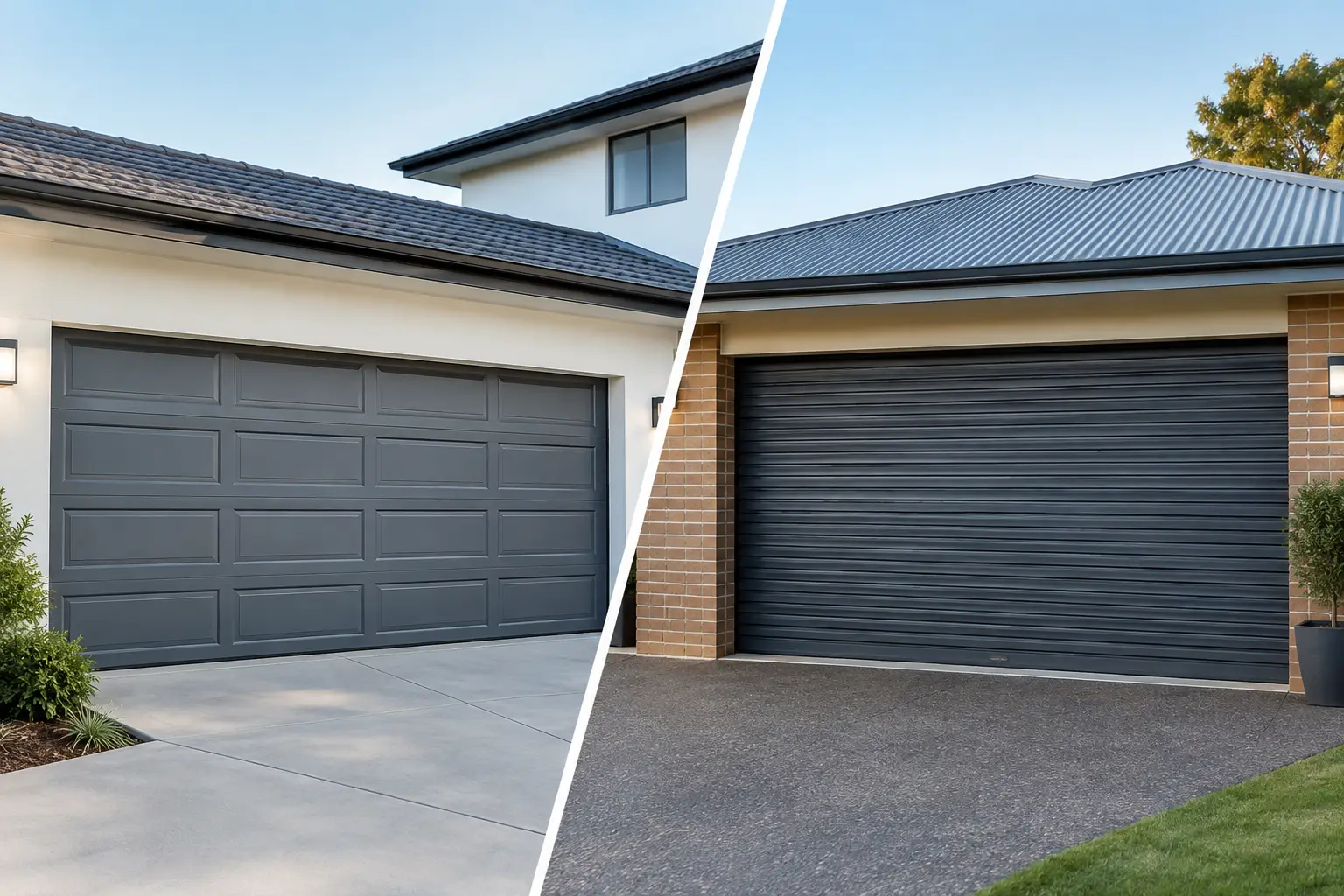
A garage door has to do more than look right from the driveway. It needs to protect vehicles, tools and stored equipment, stand up to Irish weather, and open reliably when you are leaving for work or returning home in poor conditions. When comparing sectional versus roller garage doors, the right choice usually comes down to available space, insulation requirements, appearance and how the garage is used.
Both systems can provide secure, electrically operated access when correctly specified and professionally fitted. They operate very differently, however. A sectional door travels on tracks beneath the garage ceiling, while a roller door rises vertically and coils into a compact box above the opening. That fundamental difference affects everything from headroom to internal storage options.
Sectional versus roller garage doors: the practical difference
A sectional garage door is made from several insulated horizontal panels joined by hinges. As the door opens, the panels move vertically before travelling back along tracks beneath the ceiling. The door sits close to the roof when open, leaving the full width of the opening clear.
A roller garage door is formed from interlocking aluminium slats. It opens vertically and winds around a barrel inside a box at the top of the opening. Because it does not need ceiling tracks running back into the garage, it is often a strong option where overhead space is needed for storage, lighting or other services.
Neither design is automatically better. A detached garage used mainly for parking may suit a different solution from an attached garage that forms part of the home and is used as a workshop, utility area or secure storage space.
Space and headroom inside the garage
This is usually the first technical issue to assess. A roller door keeps the ceiling area largely free, but requires sufficient clear space directly above the opening for its curtain box and guide rails. The box size depends on the door height and slat profile. On some properties, the available headroom, lintel arrangement or external façade may influence whether an internal or external box is more suitable.
A sectional door needs tracks along the ceiling and headroom above the opening. This arrangement can reduce the amount of usable roof space, particularly in a compact garage. If bicycles, kayaks or shelving are planned for the ceiling area, that needs to be considered before choosing the door.
On the other hand, sectional doors can be useful where there is limited space immediately above the door opening but adequate depth within the garage. A site survey is the sensible way to establish what will physically fit. Measurements alone do not always reveal obstructions such as beams, pipework, lighting, alarm equipment or uneven ceiling levels.
Insulation and weather protection
For a garage attached to the house, insulation can be a deciding factor. Sectional doors are commonly built with insulated sandwich panels, typically with steel skins and an insulated core. Their panel construction, perimeter seals and close fit can offer very good thermal performance when specified correctly.
Insulated roller garage doors are also available and can provide effective draught reduction and weather protection. Their slatted curtain construction, however, will not always match the insulation performance of a high-quality sectional panel door. The difference may matter if the garage adjoins a heated room, is used for hobbies or contains equipment affected by low temperatures.
Weather resistance is not simply about the door leaf. Correctly fitted side guides, bottom seals, flashing and threshold details all affect how a door deals with wind-driven rain. This is particularly relevant on exposed Irish sites, coastal properties and garages facing prevailing weather. A made-to-measure installation gives the installer scope to address the actual opening rather than force a standard-sized product into an unsuitable space.
Security and day-to-day reliability
A well-specified sectional or roller garage door can provide a strong physical barrier, especially when paired with a reliable motor, secure locking arrangement and safety controls. The best option depends on the product quality and installation standard rather than the opening method alone.
Roller doors have no outward swing and no large external handles, which can make them a neat security solution for driveways with limited space. The curtain is contained within side guides, and many electrically operated systems include anti-lift protection. They are popular where a clean, compact external appearance is wanted.
Sectional doors are also highly secure when fitted with a proper locking system and quality track hardware. Their solid panels can give a substantial feel, and there are no individual slats across the face of the door. For garages storing valuable bicycles, tools, machinery or stock, it is worth discussing security as part of the whole property approach. Door security works best alongside suitable lighting, alarms and secure side access.
Reliability depends on matching the system to the level of use. A residential garage door used twice daily has very different demands from a commercial workshop entrance operating repeatedly throughout the day. Domestic garage doors should not be treated as a substitute for an industrial roller shutter where frequent cycles, larger openings or intensive use are expected.
Appearance, light and practical use
Sectional doors generally offer more scope for a traditional or contemporary panelled appearance. They are available in a range of colours, surface finishes and panel designs, and can incorporate glazing where daylight is useful. This can suit a front-facing garage where the door makes up a noticeable part of the property exterior.
Roller garage doors create a simpler, more streamlined finish. Their horizontal slat profile suits many modern homes and can work particularly well on openings with restricted driveway space. The compact box is visible, although its impact can be reduced through careful positioning and colour selection.
If natural light is important, a sectional door may offer more options. If the garage ceiling needs to stay clear for storage or a vehicle roof rack, a roller door may be the more practical choice. Think about the door when it is open as well as when it is closed. That is where many of the meaningful differences become clear.
Cost: look beyond the initial figure
The price of either door varies with opening size, insulation level, finish, automation, access controls and any building work required. A like-for-like price comparison can be misleading because a basic single-skin roller door is not equivalent to an insulated, automated sectional system with upgraded finishes and safety features.
Installation requirements also affect cost. A garage with a sound, square opening and adequate headroom is more straightforward than one needing steelwork, timber framing, electrical supply alterations or repairs to damaged reveals. The lowest quotation may leave out details that are necessary for dependable operation and a neat finish.
For long-term value, consider servicing and repair support as well as the purchase price. Moving doors contain springs, cables, motors, tracks, guide rails and safety components that need periodic inspection. Prompt attention to unusual noise, slow movement or visible damage can prevent a smaller fault becoming a more costly repair.
Which garage door is right for your property?
Choose a sectional garage door when insulation, a premium panelled appearance, glazing options or a close-fitting door system are high priorities. It is often the stronger choice for an attached garage, a converted-use space or a homeowner who wants a broad range of finish options and has sufficient ceiling depth for the track arrangement.
Choose a roller garage door when ceiling clearance inside the garage is valuable, the driveway is tight, or a compact vertical-opening solution suits the building layout. It can be an excellent option for many domestic garages, provided there is adequate space for the curtain box and the product is specified with suitable insulation, security and weather seals.
A1 Shutters & Doors can assess the opening, discuss how the garage is used and specify a made-to-measure solution with professional installation and ongoing service support. The most dependable garage door is the one designed around the building, the available space and the way you need to use it year after year.